
Project Planning Guide
Planning Lead Times Across Multiple Material Categories
How multi-category projects sequence long-lead items, approval gates and shipping windows into one delivery programme — and why the schedule is built backward from installation.
Published
Bring the project type and the category list All Project Planning Guides

Multi-category projects succeed or fail on sequencing: long-lead items like windows and cabinetry anchor the schedule, while finish materials follow. This guide maps the approval gates, production phases and shipping windows every category passes through — and shows how to back-plan a consolidated delivery programme from installation.
Lead-time planning is a structure question, not a number question. The gates, rhythm groups and buffers on this page are what generalize across projects — specific durations are confirmed per project, because your category mix and destination market are what set them.
01
The Schedule Is Built Backward
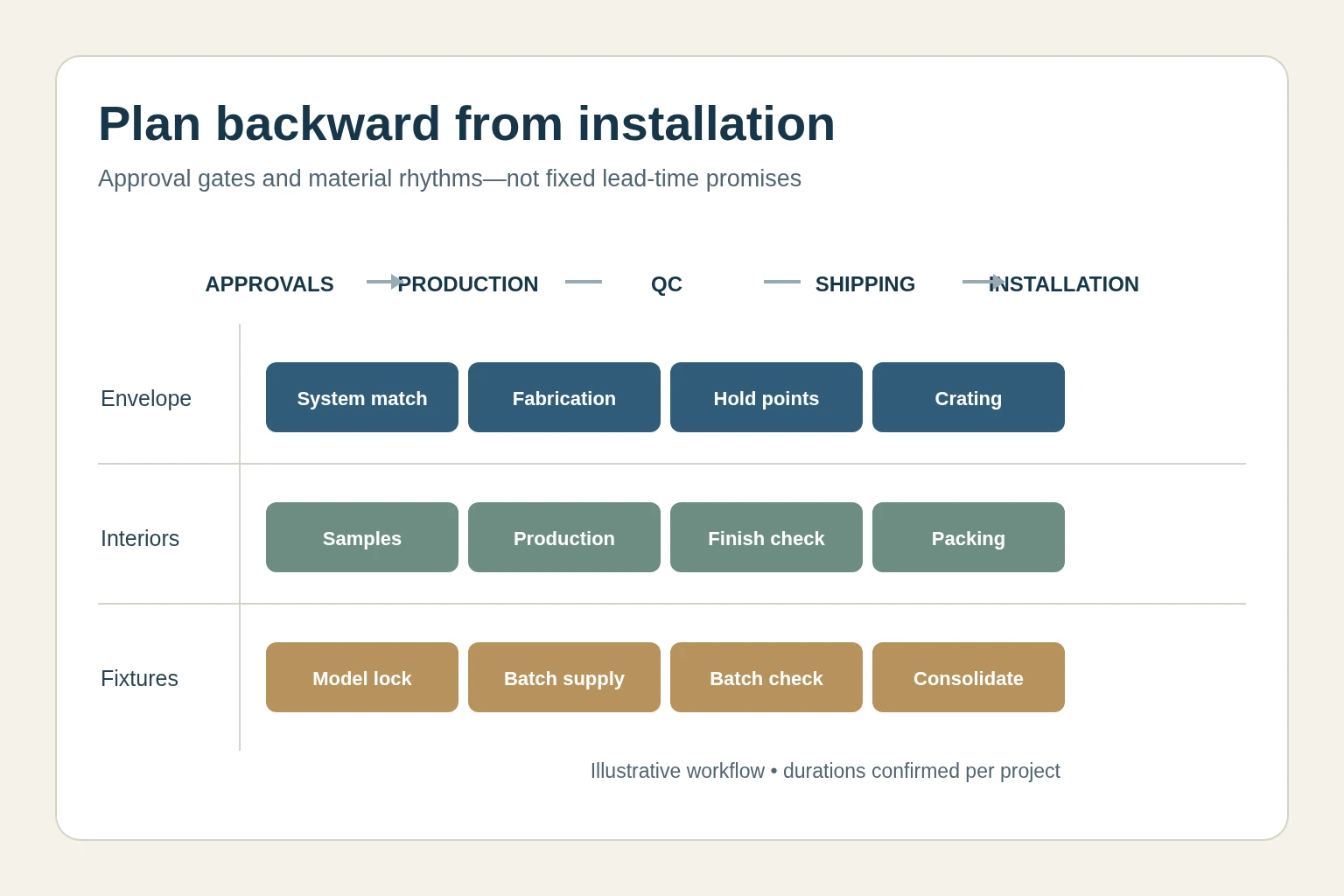
Nobody’s project timeline starts at the factory. It starts at installation — the day the joinery crew, the window installers and the stone setters need their materials on site — and works backward through shipping, QC, production, and approvals. Every category in your package has to travel that same backward path, and each one travels it at a different speed.
The mistake is treating “delivery” as one line item. A multi-category package is a relay of dependencies: drawings approved before production, production before QC, QC before packing, packing before the vessel, the vessel before customs, customs before site. Miss one handoff and the delay compounds — not adds, compounds — through everything downstream.
02
Three Rhythm Groups, Not Fifteen Categories
Category-by-category scheduling is unmanageable. Grouping by rhythm is not:
| Group | Members | Schedule character |
|---|---|---|
| Envelope & structural | Windows, doors, curtain wall, railings | Longest lead; anchors the programme; approval-heavy |
| Joinery & fitted interiors | Kitchens, wardrobes, built-ins, furniture | Long lead; shop-drawing dependent; batches by unit type |
| Finish & fixture layers | Surfaces, fixtures, hardware, lighting | Shorter lead; sample-dependent; sequenced last |
The envelope group anchors the schedule because its specification and approval gates sit early. For US, Canadian and Australian window and door packages, partner-held certificates are already available; the early task is matching the proposed model and configuration to the applicable document and resolving any project-specific evidence gaps. Curtain-wall testing remains a separate facade route. The finish group requires its own sample and approval sequence, so the programme should expose both tracks before production dates are promised.
03
The Approval Gates Every Category Passes
Each category moves through the same gates, at different speeds:
Specification approval
what it is, to what standard, for which market.
Drawing or sample approval
shop drawings for manufactured items; sealed samples for surfaces and finishes.
Production hold points
in-process QC at defined stages, not a final glance.
Pre-shipment verification
batch QC against the approved reference, packing inspection for export.
Shipping and documentation
the vessel, the customs paperwork, the compliance files for your market.
Buyers compress gate 1 and then pay for it at gate 5. A specification revisited mid-production restarts gates 2 through 4 — which is why the RFQ package you send in the first place is a scheduling document as much as a procurement one.
04
Back-Planning the Programme
Work backward, on paper, from installation dates:
- Installation date per trade, per zone.
- Site readiness — what must be built before each material arrives (storage, security, access).
- Shipping window — voyage time plus the customs clearance conditions of your market, plus buffer. Buffer is not pessimism; it is arithmetic.
- Pre-shipment QC and packing — scheduled as real activities with real durations.
- Production run — anchored by the long-lead categories; the factory’s programme slots exist before your order does.
- Approvals — specification and drawing gates placed far enough upstream that revising them does not restart production.
Then consolidate: the moment two categories can share a container, the programme gains a synchronization constraint — and the moment one category slips, you know exactly which shared shipments to re-plan rather than discovering them at the port.
05
Where Lead-Time Planning Goes Wrong
The one-number programme
“Materials arrive in X weeks” treats fifteen supply chains as one. Programmes die of that sentence.
Approvals treated as free
Every approval gate consumes calendar time even when it consumes no money — and an approval that arrives after production starts is not an approval, it is a change order.
The sample round-trip ignored
Surface and finish categories can spend a full approval cycle in sample logistics alone; a programme without sample rounds in it is a programme with invisible weeks.
Shipping buffer spent early
The buffer you allocate for customs and vessel schedules is not a contingency fund for late specification changes — those are different lines, and conflating them is how projects arrive both late and over.
Sequence-blind consolidation
Packing containers by volume efficiency instead of installation order saves freight and costs a fortnight of site chaos.
06
Consolidated Delivery With a Coordinator
This is the operational case for single-coordinator supply: one party holding the master programme, seeing every category’s gates, and sequencing production, QC and containers against your installation dates rather than against each factory’s convenience. Whether that coordinator is your main contractor or a supply integrator, the master programme must exist in one place — a programme distributed across six factories is not a programme, it is a hope with purchase orders attached.
FAQ
Frequently Asked Questions
How long do windows typically take?
Durations are confirmed per project — profile family, glazing makeup and destination market each move the answer. What generalizes is the structure: specification and drawing gates first, production, then a shipping window with buffer.
Can we speed up a project by choosing stock products?
Some categories offer stock models; windows and joinery — the schedule anchors — are engineered to your drawings. Speed usually comes from starting approvals earlier, not from buying faster products.
What happens if one category slips?
The master programme shows which shared shipments and site sequences are affected; the coordinator re-plans around the slip instead of letting it cascade. Distributed purchasing has no such map.
Should everything ship together?
Only when installation order allows it. Consolidated loading is a discipline, not a dogma — shipping in installation sequence beats shipping in volume efficiency.
How early should we start planning?
Earlier than feels reasonable. The envelope group’s approval gates sit at the start of the design programme; lead-time planning that begins at tender has already missed them.
Building a Programme for Your Project?
Bring the project type and the category list — even approximate. We will map the gates each category passes, where the long-lead anchors sit, and what a consolidated shipping plan looks like against your installation dates. Specific durations are confirmed per project during specification; the structure of the programme — gates, groups, buffers — is what we can put on paper from the first conversation.