
Buying Guide
How to Prepare a Building Material RFQ That Gets Accurate Quotes
What belongs in a building material RFQ: drawings, bill of quantities, finish references, destination standards and programme — and why each input decides how accurately a supplier can quote.
Published

A complete building material RFQ includes drawings or sketches, a bill of quantities, finish and hardware intent, destination market standards and a realistic programme. Quote accuracy depends on these inputs — missing items force assumptions, and assumptions surface later as variance, delay and dispute, not as savings.
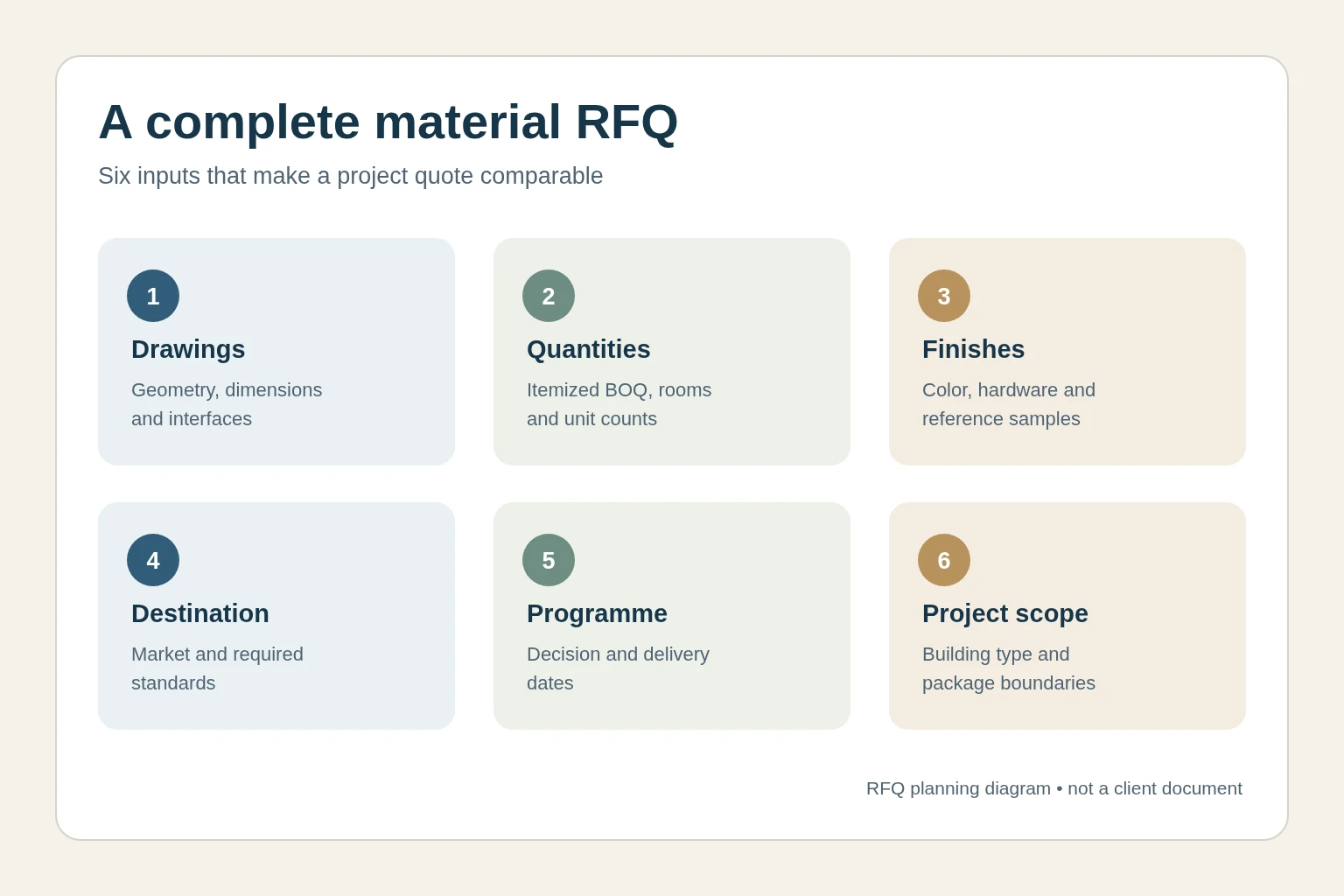
A supplier can only quote what you actually describe. Run your RFQ through the six-input checklist below before it leaves your desk — every missing input becomes a supplier’s assumption, and every assumption becomes your variance.
01
What a Complete RFQ Contains
An RFQ is not a request for prices. It is a request for a commitment — and suppliers can only commit to what you actually describe.
Before any supplier can quote responsibly, six inputs need to exist. None of them is optional, and the weakest one sets the ceiling on how accurate the entire quotation can be.
| # | Input | What it answers | Without it, suppliers must |
|---|---|---|---|
| 1 | Drawings or sketches | What is being built, at what dimensions | Guess geometry from photos |
| 2 | Bill of quantities | How many of what, where | Assume quantities and hope |
| 3 | Finish and hardware intent | What surfaces and mechanisms you expect | Quote the cheapest compliant option |
| 4 | Destination market and standards | Which codes and certifications apply | Quote to no market in particular |
| 5 | Programme | When items must arrive on site | Ignore your critical path entirely |
| 6 | Project type and scope | What the items are part of | Miss coordination you assumed was included |
The table deserves a second read, because the right-hand column is where budgets break. A quote built on guesses is not a lower price — it is a deferred argument about what was meant.
02
Drawings First: Detail Level Decides Quote Level
Drawings carry more quotation weight than any other input, and the level of drawing you provide determines the level of quote you get back.
- Concept sketches or elevations produce budgetary ranges. Useful for feasibility, useless for comparison.
- Dimensioned plans and elevations allow real pricing of profiles, panels and fabrication time.
- Shop-drawing-level detail — sections, junctions, hardware positions — allows a supplier to quote what will actually be manufactured, and to flag interface problems while they are still cheap to fix.
Send a rendering alone and you will be quoted for a picture. Send a dimensioned section and you will be quoted for a product. If only a rendering exists, annotate the key dimensions directly on it — width, height, floor-to-head — and label it “concept, budgetary range requested.” That single annotation moves the quote from a guess to a bounded estimate. If drawings are still moving, say so and request a budgetary quote explicitly — honest staging beats a false precision that neither side can stand behind later.

03
The Bill of Quantities: Format Matters More Than Totals
A BOQ that suppliers can quote line by line is more valuable than a grand total in a cover email.
- Break quantities down by item, zone and room type — one line for “wardrobe units, type A, master bedrooms, 24 units” beats a single “wardrobes” figure every time.
- Separate supply items from install-related items so scope boundaries are visible before contract, not after.
- Mark items you know are undecided as such. A flagged option is a conversation; a hidden option is a variation order.
Contrast that with “wardrobes: 24” — the supplier does not know whether that means 24 units across the project, 24 linear metres, or 24 doors, and the quote will carry a risk premium for the ambiguity. Suppliers reading a structured BOQ can challenge quantities, spot coordination gaps and identify the long-lead items that will anchor your programme. Suppliers reading a single total can only price the risk of not knowing.
04
Specifications: Name the Reference, Not the Adjective
“High quality” is not a specification. Neither is “premium finish” or “hotel standard.” Every adjective you send instead of a reference transfers the decision to the supplier — who will resolve it in the direction of their catalogue, not your design intent.
- Name the system family or profile series where one applies.
- For finishes, provide a reference sample, a RAL code or an approved equivalent clause — one anchor, not three adjectives.
- For hardware, state the intended class of mechanism (heavy-duty track, marine-grade hinge) and let suppliers propose within it.
- Where performance matters, describe the requirement and the market whose standards govern it, and ask for evidence against those standards rather than a claim of compliance.
If a specification decision is genuinely open, mark it as a priced option with the alternatives named. An open decision that is declared is a quotation line. An open decision that is silent is a dispute.
05
Destination Standards and Programme: The Two Inputs Buyers Forget
Two inputs decide whether a quoted product can legally and physically arrive at your project — and they are the two most often left out of the RFQ.
Destination market
A proposed window or door must be matched to the project’s location, configuration and required evidence. Through manufacturing partners, Starveil already offers certified aluminum window and door systems for the United States, Canada and Australia. State the destination, schedule and applicable requirements up front so the quote identifies the covered partner model and certificate; do not assume one certificate covers every size, opening type or facade system.
Programme
Suppliers plan production, finishing, QC and container loading around your dates. A programme shared at RFQ stage lets long-lead items be identified while alternatives still exist. A programme revealed at contract stage turns your schedule into the supplier’s problem — and it will be solved with rush fees or corners, not goodwill.
06
Project Type and Scope: Name What the Items Are Part Of
A window is quoted differently when it is part of a villa package, a 40-unit apartment development, or a hotel fit-out. The same product carries different coordination requirements, batch logistics and interface risks — and a supplier cannot infer which scope it sits inside from the product alone.
- State the project type (villa, apartment, townhouse, hotel, light commercial, renovation) and the delivery context (new build, occupied-home renovation, phased handover).
- State what the items are coordinated with — e.g. “these windows coordinate with a third-party facade system” or “this kitchen interfaces with our own bathroom joinery package.” That single sentence prevents a supplier from pricing window-only supply when the interface was expected included.
- For multi-unit projects, note the unit-type count and repetition — a supplier prices one-off joinery and repeated joinery differently.
The goal is not to hand the supplier your whole project plan. It is to tell them which scope boundary they are quoting inside, so “included” and “excluded” are the same sentence for both sides.
07
How Input Precision Maps to Quote Confidence
| You provide | You get back | Safe use |
|---|---|---|
| Concept images | Budgetary range | Feasibility studies only |
| Dimensioned drawings | Comparable pricing | Shortlisting suppliers |
| BOQ + finish references | Line-item quotation | Contract preparation |
| Full package + programme | Commitment-grade quote | Ordering decisions |
Skipping a level saves days and costs weeks. Each row exists because the inputs above it cannot support the decision being made on it.
08
Where RFQs Go Wrong
The photo quote
Sending supplier photos from another project and asking for “the same.” Photos carry no dimensions, no specification and no finish schedule.
The moving target
Revising drawings silently across email threads. Version your RFQ; reference the version in every reply.
The silent market
Omitting destination standards, then discovering the quoted product cannot be certified for your market.
The total-only BOQ
Forcing suppliers to quote against a number instead of a list — comparison becomes impossible and every line is an argument.
The unpriced option
Leaving alternatives inside the specification unmarked. Suppliers price the cheaper one; the change surfaces at approval.
The RFQ broadcast
The same package sent identically to twenty suppliers gets twenty template replies and no one reads it closely. A package sent to three suppliers genuinely capable of your scope gets read — and quoted to the actual specification.
FAQ
Frequently Asked Questions
Can I request a quote with drawings only?
Yes — declare it as budgetary. The quote will be a range with assumptions listed, and every assumption will need resolving before contract.
What is the difference between an RFQ and an RFP?
An RFQ asks what defined items will cost — you describe the product, the supplier prices it. An RFP asks how a supplier would approach an outcome — the scope is open and the supplier proposes the method. Multi-category material projects usually start with an RFQ on defined items, then shift to an RFP when coordination strategy matters more than unit price.
Should finish selections be final before quoting?
No, but they should be declared. Priced options keep unfinished decisions visible instead of guessed.
Do I need a BOQ for a single villa?
Yes — smaller. A villa BOQ may be one page, but itemized. Single-line totals create single-line disputes.
How do destination standards change a quote?
They determine which proposed configuration and supporting document can be used. Our partners hold aluminum window and door certificates for US, Canadian and Australian projects; the RFQ must identify the destination and product schedule so we can match the covered model, glazing and hardware to the right document.
What happens if my programme changes after quoting?
Production slots, finishing queues and container plans re-sequence. Share the revised programme early — a moved date is a plan; a hidden date is a breach.
Preparing an RFQ for Starveil?
Send what you have — we will tell you what is missing before quoting, not after. A typical package includes drawings at whatever level exists, a BOQ draft, finish references or samples, your destination market and your target programme. Where inputs are still open, we quote them as declared options so the basis of every number is visible.
The readiness review itself is part of the response — included with every RFQ reply rather than billed separately. It is also where most quotation variance is prevented before production begins.