
Exterior Doors · Pivot Entrances
Aluminum Pivot Doors for Villa and Hotel Entrances
Pivot doors for villa and hotel entrances: offset-hinge engineering, oversized single-leaf capability, finish and hardware options — confirmed per project during specification.
Send the opening dimensions and your design intent All Exterior Doors

Pivot doors rotate on offset hinges set within the door slab rather than at its edge, enabling oversized single-leaf entrances that conventional hinges cannot carry. Starveil manufactures aluminum pivot doors for villa and hotel entrances in Foshan, with leaf sizes, finishes and hardware confirmed per project during specification.
Pivot entrances are sized to their mechanism: leaf dimensions, anchorage requirements and hardware class are resolved against your opening and structure at specification — so the door that arrives is the door your building can carry.
01
The Entrance as a Statement, Engineered
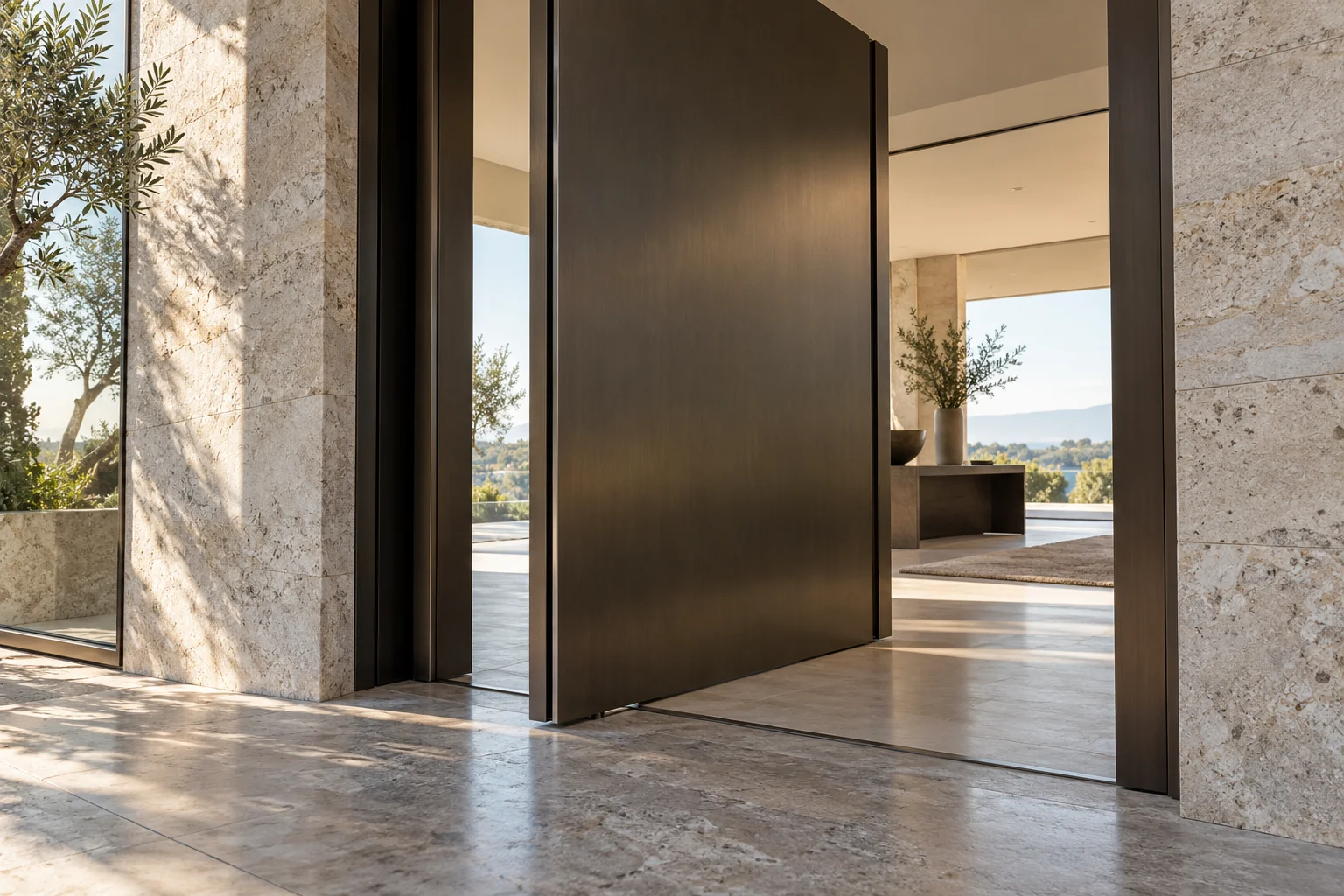
A pivot door does one thing a hinged door cannot: it makes a single oversized leaf credible. The hinge points sit within the slab itself — top and bottom, offset from center — so the leaf spins on its own axis instead of hanging from one edge. The weight that would tear a conventional hinge out of its frame becomes, in a pivot system, the thing that keeps the door stable.
The visual signature follows the engineering: no visible butt hinges, a clean vertical reveal, and a leaf that can run taller and wider than edge-hung doors dare. For villa entrances and hotel lobbies, that combination — monumental scale with quiet hardware — is the entire point.
02
Where Pivot Doors Belong
- Villa main entrances, where the front door sets the project’s tone before anyone steps inside.
- Hotel and resort lobbies, where entrance doors operate at high cycle and must survive luggage carts and service traffic.
- Pool and garden access points, where a statement leaf meets an indoor-outdoor brief.
- Commercial frontages, where the entrance is the brand’s first line.
A pivot door is a choice about emphasis. Where the brief asks the facade to fold away entirely, large-opening bi-fold systems are the answer; where it asks one panel to be unforgettable, this is the one.
03
What Pivot Engineering Has to Get Right
The pivot mechanism carries loads that edge hinges never see, so the engineering conversation is short but non-negotiable.
Leaf scale vs. mechanism class
Oversized single-leaf capability is real but bounded — the mechanism class is selected to the leaf, and the leaf is sized to the mechanism. Both are confirmed per project during specification, because a pivot door quoted without its leaf dimensions is a door that has not been engineered yet.
Floor and header anchorage
A pivot carries its loads to the floor and the head of the opening, not to the jambs. That means the builder’s substrate and header are part of the door system — coordinated during specification, not discovered during install.
Weather at the offset
Because the leaf sweeps on an offset axis, sealing geometry differs from conventional doors; sill and perimeter weather strategy follow the exposure of the actual site.
Operation feel
A well-specified pivot closes with authority and rests in alignment; the closing strategy — self-closing hardware where codes require it — is part of the specification.
04
Finishes, Glazing and the Design Layer
Finishes
Powder coating across the full color range and anodized options, specified by reference sample or code — the entrance is the last place for “bronze-ish” as a specification.
Glazing
Full-height vision, slit glazing, solid insulated panels or a combination — glazing makeup is coordinated with the entrance’s orientation and the envelope discussion.
Hardware
Pull and push plates scaled to the leaf, closer mechanisms matched to cycle expectations, and locking classes appropriate to an entrance application.
Threshold options
Flush where exposure allows, weather-rated sills where it does not — chosen with the site, not from a brochure default.
05
The Evidence Boundary
Starveil coordinates pivot-door fabrication, hardware integration and hold-point QC in Foshan. Our manufacturing partners hold aluminum-door certification documents for the United States, Canada and Australia, but those documents are cited on this page only if the selected pivot model and configuration are within their stated scope. A certificate for another door opening type is not evidence for a pivot door. The project submittal identifies the actual fabricator, certificate holder and applicable model; otherwise the pivot door’s required test route is confirmed separately.
06
From Entrance Design to Container
Entrance review
opening dimensions, leaf intent, exposure and anchorage conditions.
Configuration lock
leaf makeup, glazing, finish, hardware class and closing strategy.
Production and QC
fabrication with in-process hold points, including the pivot mechanism assembly.
Packing and loading
oversized-leaf export packing engineered for the route.
FAQ
Frequently Asked Questions
How large can a single pivot leaf be?
Leaf capability follows the mechanism class, the glazing makeup and the anchorage — sized per project during specification, not quoted from a catalogue ceiling.
Do pivot doors seal as well as conventional doors?
Sealing geometry differs and is engineered to the site’s exposure; weather-rated strategies are available where the entrance faces driven rain.
Are pivot doors suitable for high-traffic entrances?
Yes — hotel lobby applications select hardware and closer classes for high-cycle operation.
Can a pivot door be double-acting?
Double-acting configurations are assessed per project against closing, locking and code requirements.
Pivot or bi-fold for our entrance?
A pivot door is a statement single leaf; bi-fold systems open entire walls. Bring the entrance’s role in the design and the answer is usually obvious — see the large-opening systems page for the other conversation.
Planning an Entrance?
Send the opening dimensions and your design intent — a rendering, a reference image, or just the ambition. We will tell you what the leaf can be, what the mechanism requires from your structure, and what gets confirmed at specification.