
Technical Guide · 03
Joinery That Survives Export: Construction Standards for Project Cabinetry
Showroom cabinetry is built to survive a showroom. Project cabinetry — and the joinery construction behind it — must survive a factory, a container, a port, a construction site and then decades of daily use. (Many markets call this scope “joinery”; US specifications call it “cabinetry” — this guide uses the US term.) This guide explains the construction decisions that make the difference, and how to read them in a specification.
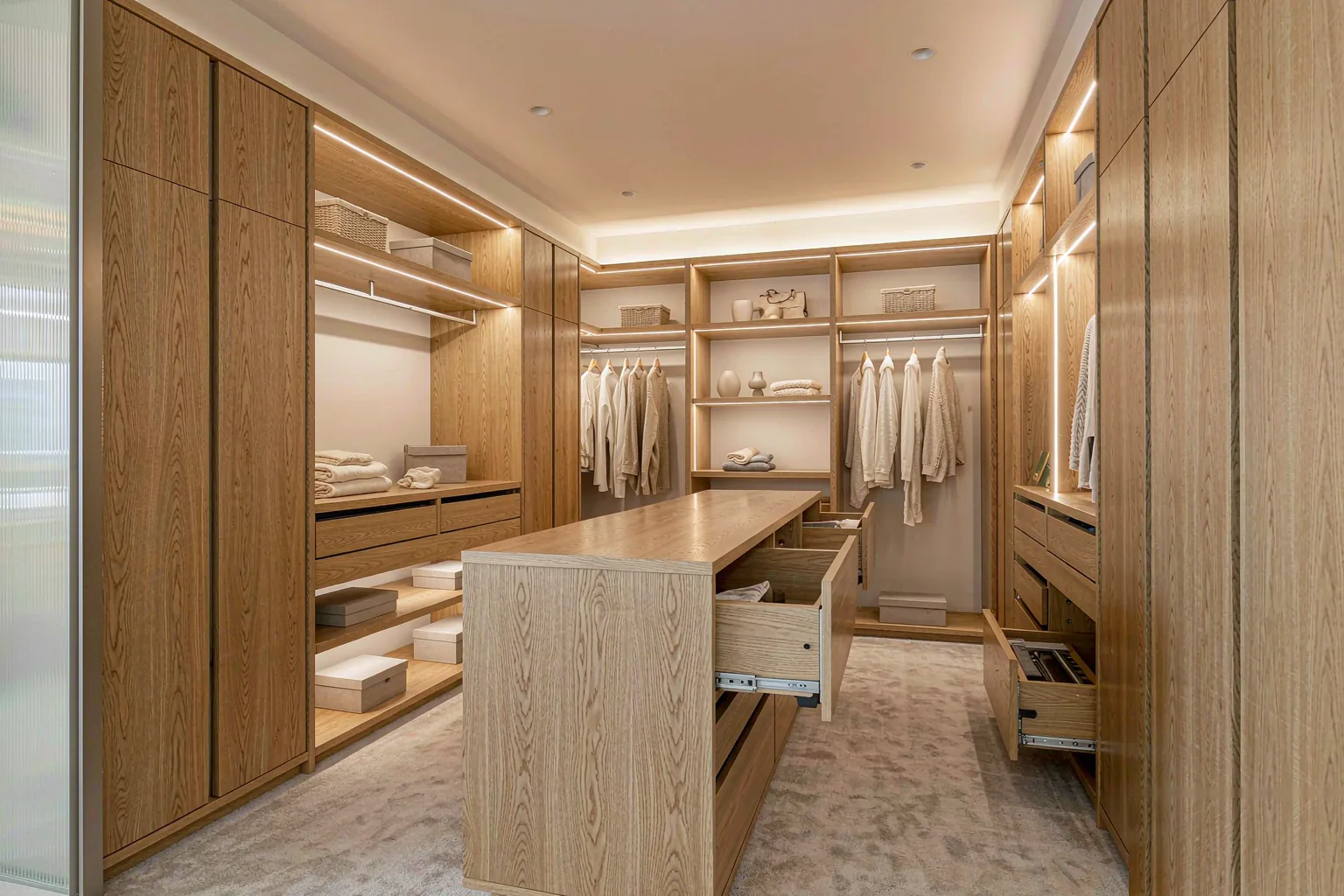
Judge cabinetry by four layers: carcass, fronts, finishes and hardware. Ask where each material is used — plywood in spans and wet areas, MDF in painted fronts, particleboard only in low-load panels. Require sealed edges, adjustable anchorage and export-grade packing. Approve construction from a physical sample and a cut list rather than a rendering.
On this page: Carcass Materials · Box Construction · Door Fronts · Hardware · Wet Areas · Export & Site · FAQ
Part 01
Carcass Materials and Where They Belong
“Solid wood everywhere” is a showroom answer. Project-grade cabinetry is an engineering answer.
Plywood
Cross-laminated layers give it the best strength-to-weight and the best behavior in spans, shelves and wet-area carcasses. Look for certified structural grades, and marine-grade plywood where exposure is sustained.
MDF
Dimensionally stable, flat, and the correct substrate for high-quality painted finishes. Unsuited to sustained water exposure; use moisture-resistant MR-MDF where humidity is periodic rather than wet.
Particleboard
Economical for low-load interior panels in furniture. Heavier, weaker at fixings (a shelf that sags at standard spans) and vulnerable to moisture, so its place in a project is a deliberate decision. Emissions compliance — CARB Phase 2, administered in the US under EPA TSCA Title VI — is the floor for any composite board.
Moisture content matters
Materials leave the factory at controlled moisture. Poorly dried board shows up months later as warping fronts and joint cracking — invisible on delivery day, expensive on installation day.
Part 02
Box Construction Methods
How the box is joined decides how it survives shipping and years of load.
Dowel and cam construction
Factory-machined on the 32 mm system of pre-drilled hole patterns — precise, and the standard for flat-pack project delivery. Repeatability across one hundred identical units is where it wins.
Glued and screwed assembly
Rigid and serviceable, suited to assembled delivery of fixed cabinetry. Choose it where cabinets arrive assembled and site labor is scarce; choose dowel-and-cam where one hundred units must ship flat and assemble fast.
Back panels and load paths
Thin nailed-on backs rely on the wall; structural backs make the box self-supporting. The difference matters on out-of-true walls and in seismic regions.
Flat-pack engineering
Flat-packed cabinetry protects finishes in transit and loads containers efficiently, but only when the knock-down hardware and site assembly plan are engineered as part of the design.
Part 03
Door Fronts
Fronts are the largest visible surface in an interior, and the highest warping risk.
Slab vs framed fronts
Slabs show grain or lacquer continuously; framed fronts (such as shaker profiles) hide seasonal movement better. Large painted slabs are the highest-risk combination, and panel construction or engineering support should back them.
Veneer
Real wood appearance over stable substrates. Matching across a whole project is a genuine skill: sequential leaves, consistent finishing, and matched crowns on visible elevations separate project-grade veneer work from commodity panels.
Lacquer finishes
Finish quality lives in preparation and process — sanding sequence, primer builds, and cured-between-coats discipline. A thin finish fails first at edges and handles.
Handles or handleless?
Handleless profiles (gola channels, milled grips) put the touch-point on the cabinet itself. Test the hardware on a sample: a handleless kitchen that needs fingernails to open fails daily.
Part 04
Hardware
Hardware is the mechanical half of cabinetry quality.
Hinges
Soft-close is a grade, not a feature. Weight ratings, opening angle and service-life cycles differ between grades. On tall doors and integrated appliances, specify the rating.
Drawer systems
Undermount slides carry more, run truer and hide better than side-mount. Load ratings, extension type (partial, full, over-travel) and sync-on wide drawers define the daily experience.
Internal fittings
Pull-outs, lifts and dividers should be specified per zone of use. A pantry, a wardrobe and a vanity stress hardware differently.
Anchorage
Wall-hung cabinets are only as good as their hanging systems and the wall behind them. Adjustment range in the hanging rail absorbs real-world wall tolerance.
Part 05
Wet Areas and Bathrooms
Bathroom cabinetry fails at the same places every time.
Substrate choice
Moisture-rated board (MR-MDF) or plywood only. The vanity and any storage in splash zones is not the place for commodity panel.
Edge sealing
Every cut edge is an entry point. Edge banding type and the sealing of machined cutouts (taps, basins) determine whether a vanity survives year three.
Countertop interfaces
The joint where counter meets cabinet, and where basin meets counter, should be specified with the basin and faucet rather than chosen at installation.
Ventilation reality
Specification can manage splash; only the building’s ventilation manages vapor. Cabinetry in bathrooms should assume condensation happens.
Part 06
Export and Site Survival
What the journey demands, and how specification answers it.
Moisture-stable materials
Container environments swing in humidity. Kiln-dried, sealed materials travel better than green or unsealed stock.
Protected packing
Corner protection, interleaving and finish-face protection decide whether the factory’s quality arrives. Ask to see the export packing method for prior projects, in photos.
Sequenced delivery
Site-friendly packing means cartons are labeled to the plan, deliverable by zone, and installable in order. Packing is a scheduling tool, not an afterthought.
Site tolerances
Scribe gaps, adjustable legs, and shimmed anchorage absorb the difference between a perfect drawing and a real wall. Specify adjustability, or the site will improvise it.
FAQ
Frequently Asked Questions
Short answers to the questions buyers ask most about this topic.
Should wardrobe carcasses be solid wood?
A showroom answer. Engineered carcass materials placed correctly — plywood in spans and wet areas, MDF in painted fronts — outperform solid wood in stability, cost and delivery.
Can MDF be used in bathrooms?
Only moisture-resistant MR-MDF, and only where humidity is periodic. Sustained splash zones call for plywood or marine-grade plywood as the carcass substrate.
Does flat-packing mean lower quality?
No. Flat-pack delivery is an engineering choice: 32 mm system construction, knock-down hardware and a site assembly plan designed with the cabinetry. It protects finishes in transit and loads containers efficiently.
Keep Reading
Related Pages
Wardrobes & Closet Systems
Hinged, sliding, walk-in and open systems engineered from project drawings.
About the Author
Starveil Solutions Engineering & Technical Team
This guide is written by the technical team responsible for specifying, coordinating and quality-controlling coordinated building-material packages on projects across the United States, Australia, the Middle East, Europe and Southeast Asia. More about our engineering support ›
Published 16 September 2026 · Part of the Technical Guides series
Specify Cabinetry Like It Will Be Shipped, Because It Will
Kitchen cabinetry, wardrobes and project furniture are manufactured in our own facilities — specified, packed and shipped as part of a coordinated material package.