
Technical Guide · 01
How to Read Window & Glazing Performance Claims
A window performance number is a measurement taken under specific test conditions — not a property of the window you will receive. This guide explains what the main ratings describe, why they translate imperfectly to real projects, and what evidence to request before approving a glazing specification.
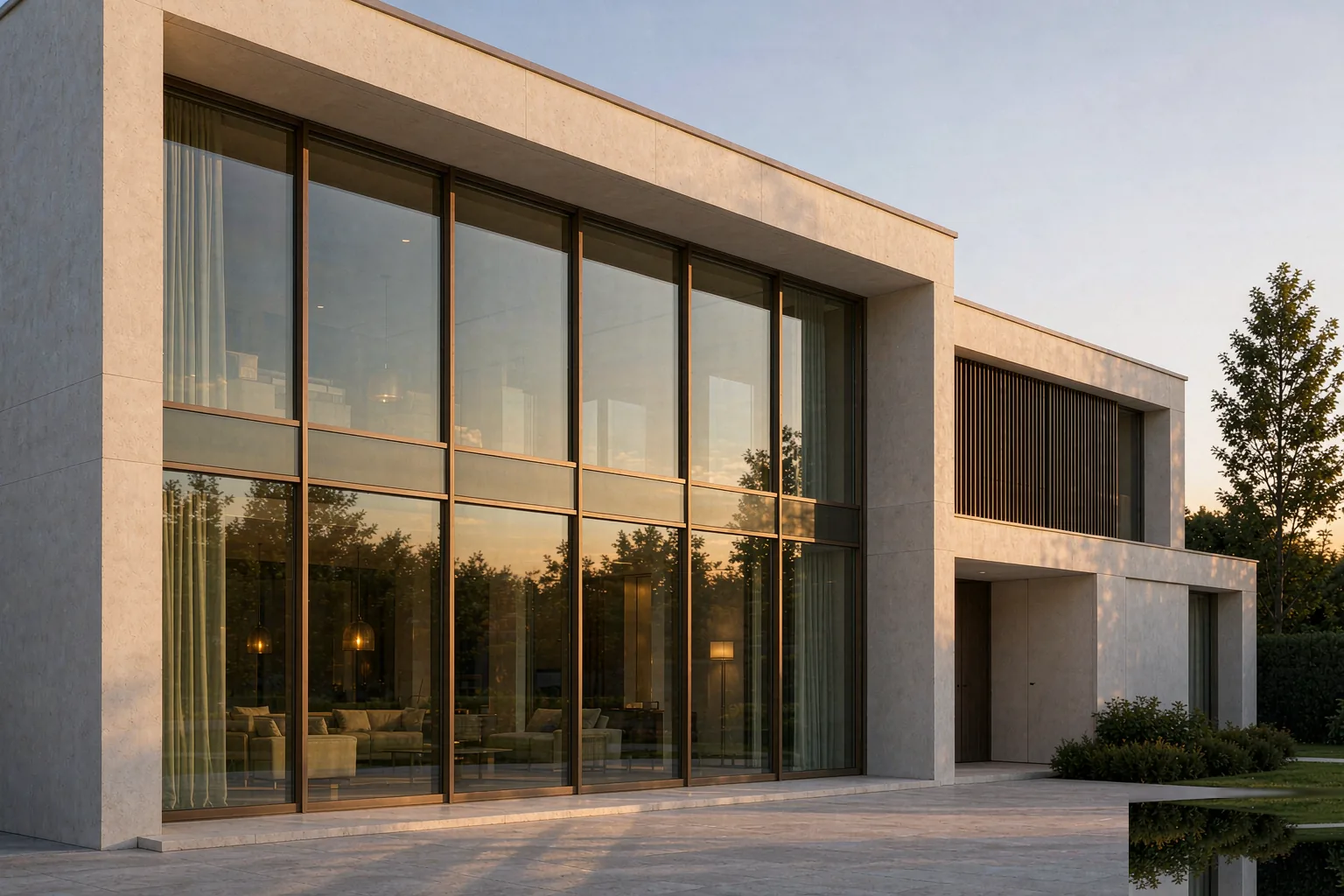
Read the rating, the test behind it, and the configuration it was tested on. Values belong to a specific size, glass build, frame and standard edition, so they do not transfer automatically. Ask for the test report, match it to your openings and local code, and treat numbers that cannot be evidenced as supplier risk.
On this page: U-Value · Solar Heat Gain · Air, Water & Structural · Why Values Don’t Transfer · What to Ask · FAQ
Part 01
What a U-Value Actually Describes
A U-value describes heat transmission — and what it measures, under which conditions, changes everything.
Whole-window vs center-of-glass
Two numbers circulate in the market. Center-of-glass values always look better because they exclude the frame, the spacer and the edge-of-glass effects. Only whole-window values describe the product being purchased. In North America, the NFRC label is the whole-window benchmark; elsewhere, always ask which one you were quoted.
Lower is better, context is everything
A lower U-value means less heat transmission, but the meaningful difference between two systems depends on your climate, heating strategy and the share of envelope the glazing represents. A one-step improvement on a single bedroom window is not the same calculation as across a thirty-foot glass wall.
The frame is part of the number
The same insulated glass unit performs differently in a thermally broken frame than in one without a break. Ratings belong to assemblies, not components.
Test conditions are fixed conditions
Laboratory values are measured at defined temperature differences and surface conditions. Your building’s real performance moves with wind, night-sky exposure, occupancy and internal shading. Treat quoted values as a baseline to be confirmed, not a prediction of your building’s performance.
Part 02
Solar Heat Gain and Daylight
Solar control is a design decision per orientation, and a single global setting cannot serve every elevation.
SHGC in one sentence
The solar heat gain coefficient describes how much of the sun’s energy hitting the glass ends up as heat inside. Lower values reduce heat gain — desirable on west-facing glass in hot climates, counterproductive where winter passive gain is part of the design.
Visible transmittance is the other half
Tinting and coatings that cut heat also cut daylight. A low-SHGC, low-VT glass can leave rooms permanently dim and push lighting loads up. Ask for both numbers together.
Orientation changes the answer
North glass, west glass and skylights want different coatings. A single glass build applied to every elevation is a design compromise, not a specification.
Coatings are invisible decisions
Low-emissivity coatings sit inside the insulated unit. You cannot see which one was used, which is why the glass build must appear in the specification and the approval documents as well as the quotation.
Part 03
Air, Water and Structural Ratings
These ratings describe how the window behaves under weather, as tested, in one configuration.
Air infiltration
Describes air leakage through the closed window under defined pressure. In North America the test method behind it is typically ASTM E283, feeding the AAMA/WDMA/CSA 101 rating family. It is a comfort and energy number, not just a cold-draft number.
Water penetration
Describes resistance to driven rain at defined pressure differentials — typically ASTM E331 in North America, with EN test methods serving the same role across much of Europe and Asia. This rating, and its test size, matters most for exposed coastal and high-rise elevations. Picture wind-driven rain on a coastal high-rise at night: this rating is what the sill relies on.
Structural / design pressure
Describes the wind load the tested window withstood, typically via ASTM E330 in North America. Design pressure classes differ between regions and standards editions; a class certified in one market does not automatically satisfy another.
The size problem
Ratings are earned on specific test sizes. Larger units, heavier glass and different aspect ratios behave differently. When your openings differ from the tested configuration, the value needs re-confirming rather than re-asserting.
Part 04
Why Tested Values Do Not Transfer Automatically
Four gaps sit between a test report and your installed window.
Configuration gap
Test reports describe one combination of frame, glass build, size and hardware. Your project’s units vary across all four.
Code gap
Wind-load classes, egress and safety-glass requirements differ by market and code edition — in the United States, energy provisions trace to the IECC as each state adopts and amends it. Compliance is a per-region, per-project question.
Installation gap
Installed performance depends on anchorage, sealing and insulation of the opening. A rating does not survive a poor installation.
Edition gap
Test standards get revised. A report issued under an older edition may not satisfy a current requirement. The report date and standard edition are part of the evidence.
Part 05
What to Ask a Supplier
Six requests that separate evidence from marketing.
Show the report, not the number
Ask any supplier quoting a rating to produce the test report behind it, matching the system, glass build and frame you are buying.
Confirm the tested configuration
Ask which sizes and configurations were tested, and how they map onto your openings.
Confirm code relevance
Ask whether the system has been assessed against your project’s jurisdiction, and what the pathway to confirming it looks like.
Specify the glass build
Coating type, spacer, cavity and gas fill should appear line by line in the specification rather than being summarized as “double glazed.”
Disclose the exclusions
Rating exclusions (screens, certain configurations, site-applied elements) are common and legitimate when disclosed. Ask for the list.
Confirm values per project
The correct answer involves your drawings. If a supplier answers with a brochure, ask again. At Starveil, performance values are confirmed against project drawings during specification, and no generic performance tables are published.
FAQ
Frequently Asked Questions
Short answers to the questions buyers ask most about this topic.
Are center-of-glass and whole-window U-values interchangeable?
No. Center-of-glass values exclude the frame, spacer and edge-of-glass effects, so they always look better. The NFRC label in North America reports whole-window values; in other markets, ask explicitly which one a quotation uses.
Does a test report from one country satisfy another market’s code?
Not automatically. Rating classes, standard editions and acceptance criteria differ by jurisdiction. The report is evidence; whether it satisfies your code is a per-project confirmation.
Why doesn’t Starveil publish standard performance tables?
Because values are confirmed per project during specification, against your drawings. A generic table cannot evidence your configuration, and we would rather show you the report that can.
Keep Reading
Related Pages
Hurricane Impact Windows
What impact-rated systems involve, and why parameters are confirmed per project during specification.
Engineering Support
Shop drawings, BOQ review and specialist engineering — the coordination layer behind every package.
About the Author
Starveil Solutions Engineering & Technical Team
This guide is written by the technical team responsible for specifying, coordinating and quality-controlling coordinated building-material packages on projects across the United States, Australia, the Middle East, Europe and Southeast Asia. More about our engineering support ›
Published 16 September 2026 · Part of the Technical Guides series
Specify With the Report, Not the Brochure
If a glazing performance question is blocking your specification, our technical team answers with test reports and project evidence, and confirms every value against your drawings before production.